Welcome to Module 3: Difficulties with Executive Function
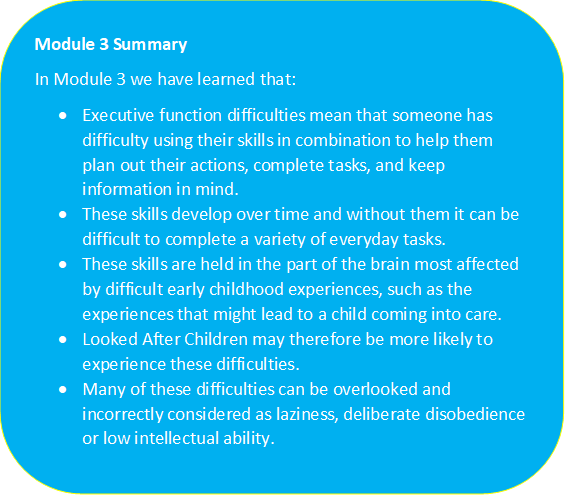
Now that we understand more about what Executive Function is, we can look at how difficulty with Executive Function, can affect individuals. These difficulties often appear to others as problematic behaviour which is deliberate and intentional in nature.
 The video below, produced by Anne Ginnett as part of her TEDx talk, discusses some ways Executive Function can be impaired, even in those of us with typically good Executive Function abilities. As you watch the video can you think of any occasions where you have noticed these difficulties in yourself or others? Would you think differently about those incidents now?
As described in the video, the most common difficulties that occur when your Executive Function is impaired are as follows, click on each heading to find out more:
We all might experience some of these difficulties at times, but when someone is having difficulty with Executive Function, they will experience these difficulties more often, and more intensely, than more typically functioning individuals. Many of these difficulties are interpreted negatively because they are misunderstood. For example, not being able to initiate tasks can appear as laziness, failing to complete a requested task successfully could look like deliberate defiance, and not concentrating in class might look like disobedience.
So why might care-experienced children be more at risk of these difficulties?
Environmental Factors
Children may be taken into care for different reasons, but a large proportion of children are accommodated because of neglect and abuse. In fact, according to 2016 figures from the Department of Children and Families, 60-62% of care-experienced children in England and Wales were accommodated for these reasons. These kinds of experiences are often referred to by the umbrella term ‘Trauma’. Psychological trauma, is an emotional or psychological injury resulting from an extremely stressful or life-threatening situation. It can occur in relation to a variety of negative life experiences including physical, sexual, and emotional abuse, as well as physical and emotional neg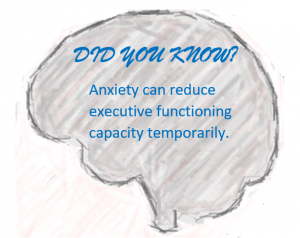 lect.
lect.
The frontal lobe, the part of the brain responsible for Executive Function has been shown to be particularly sensitive to the effects of traumatic experiences in childhood. Children exposed to prolonged trauma will spend more time using the part of their brain that is focused on survival, making the connections related to the most basic functions of the brain faster and stronger over time. Given that brain development is focused around the functions needed for survival, some of the higher functions affected by trauma can develop later or less fully.
Genetics
There are some indications that Executive Function difficulties can be hereditary within families. Care-experienced children are often from families with long standing difficulties where their parents may experience similar difficulties, which are then passed on through genetics. However, it is very difficult to separate the impact of genetics from the child’s environment.
Other Issues
Certain conditions are also linked with Executive Function difficulties, for example, ADHD, Dyslexia, mood disorders such as depression and anxiety, Autism Spectrum Disorder, Foetal Alcohol Spectrum Disorder, and various neurological conditions. Co-occurring problems are known as co-morbidities or co-morbid issues.
So what can we do to support people with Executive Functioning Difficulties?
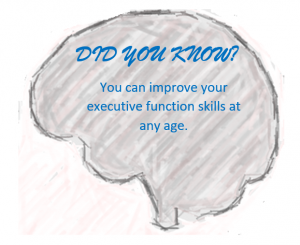
The good news is that Executive Function skills develop progressively, meaning they will mature at different rates for different individuals. They also continue to develop well into early adulthood. Therefore, in younger people these skills may be delayed rather than absent or damaged. Children and adolescents can be supported to manage these weaknesses using particular supports and strategies. However, depending on their level of difficulty, individuals who struggle with Executive Function may continue to require extra help and support as adults. The same techniques can be used at any age to boost Executive Function skills.